Extra-low voltage ceilings
Fittings are fed from the PoE infrastructure, not from 240V circuits threaded through the ceiling. The cabling to each light is data cabling.
Brisbane · Offices & fitouts · smartengine platform
Commercial PoE lighting powers and controls every fitting over network cable — with occupancy sensing, daylight dimming and live energy data built into the same infrastructure. We design and install PoE lighting for Brisbane offices and fitouts.
In a conventional fitout, lighting means 240V circuits to every fitting, separate control wiring, and an electrician for every churn. In a PoE fitout, every LED fitting and every sensor hangs off a network switch on a single Cat6 run — extra-low voltage, centrally powered, individually addressable.
Move a wall, re-zone a floor, change what a room is for — the lighting follows with software and patch leads, not rewiring.
Fittings are fed from the PoE infrastructure, not from 240V circuits threaded through the ceiling. The cabling to each light is data cabling.
Dim, group and schedule each fitting individually. Zones are software, so the lighting plan can change as fast as the floor plan does.
Occupancy, daylight and environmental sensors plug into the same infrastructure — lights that dim near windows and switch off in empty rooms, without a separate control system.
Consumption is measured at the port, per fitting, in real time — actual data for your energy reporting instead of estimates.
We build on smartengine — network-powered PoE lighting deployed across 500+ commercial projects and 1.8 million m² worldwide.
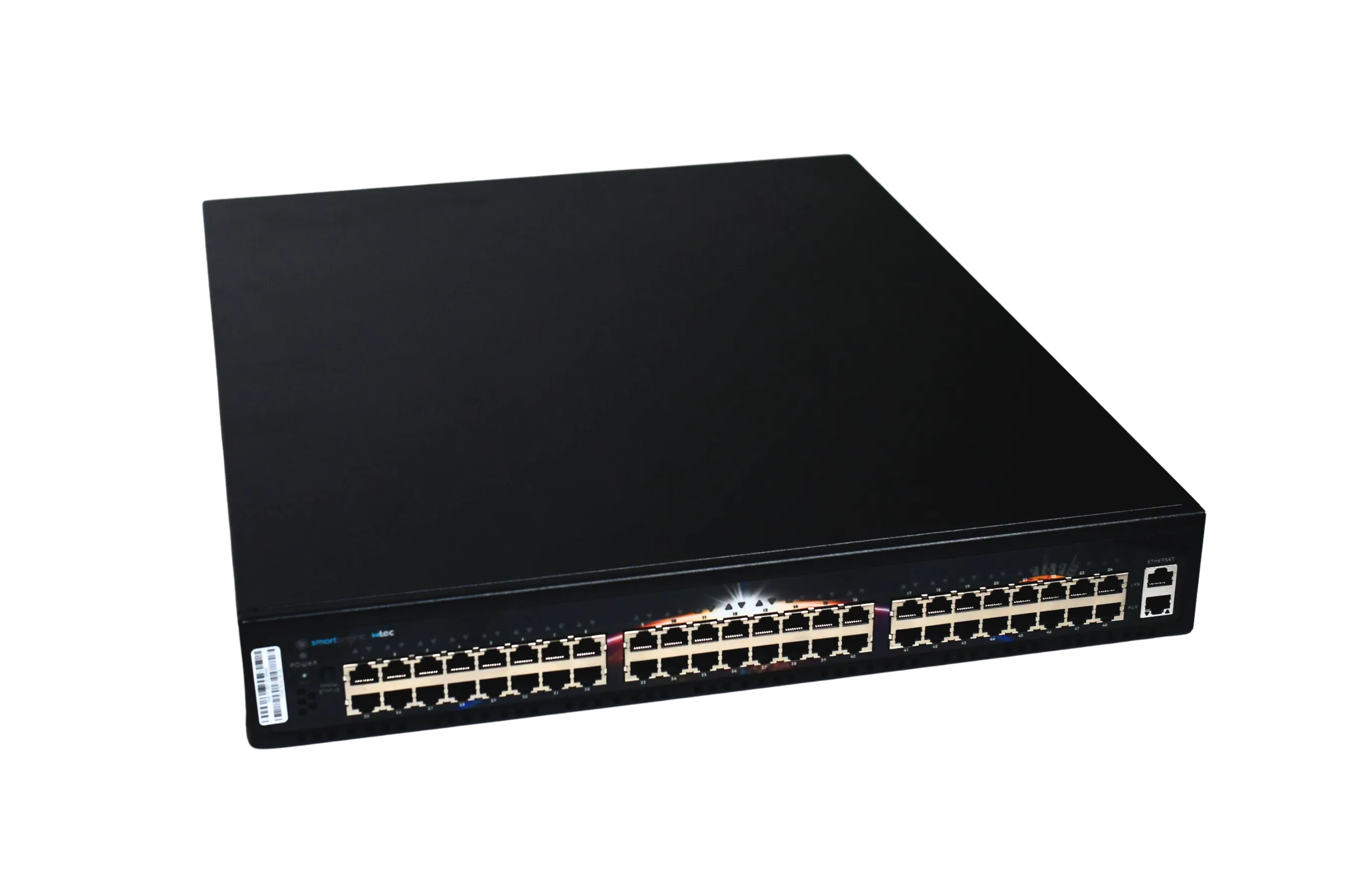
A 1RU rack unit with 48 power/data ports, up to 34 W each — 2,200 W of lighting, sensors and wall switches from one box in the comms room.
Manufacturer-neutral LED fittings — panels, linear, downlights — chosen to suit the space and connected over Cat6.
Occupancy, daylight and environment sensors — and the wall switches themselves — run off the same 18–48 V ports as the lights.
Zoning, schedules, scenes and per-fitting energy data — handed over configured and documented.
Every project is engineered: fitting counts, lux levels, cable runs and PoE budget are all in the lighting plan before anything is ordered.
Assumes 30 W per fitting. Ports run out before watts do: 48 fittings is only about 1,440 W of the engine's 2,200 W, so the port count is what sizes the job. The real lighting plan measures your actual fixtures.
Luminaires can be ordered with a tunable-white option, typically 2700K–6500K. Otherwise the colour is fixed at order — commonly 3000K, 3500K or 4000K. Which way you go is a decision we make in the lighting plan, not something to retrofit later. The UniFi Protect floodlight is a fixed-colour fitting: its brightness adjusts in the app, its colour temperature doesn't.
This is the cheapest time PoE lighting will ever be. The data cabler is already on site, ceilings are open, and every Cat6 run to a light costs a fraction of a new 240V circuit. We work to your builder's program — cabling at rough-in, fittings and commissioning at the end.
Suspended T-grid ceilings make offices genuinely retrofittable — tiles lift, Cat6 goes in, fittings swap. It can be staged floor by floor or room by room, after hours if the space is in use. The site walk tells you exactly what's feasible before you spend anything.
Fitout builders and electricians: we work alongside your trades — the lighting plan slots into your program. Lighting a yard or perimeter instead? That's our smart security lighting side, and for a house rather than a workplace see PoE lights at home.
The fittings and their cabling are extra-low voltage — fed over Cat6 from the PoE infrastructure. The engine itself takes a normal supply, and decommissioning existing 240V lighting is electrician work — we coordinate both as one job.
Same as conventional lighting — though because power is centralised, UPS backing on the engine can carry selected fittings through short outages. Statutory emergency and exit lighting remains its own compliant system, as in any fitout.
No — the platform is manufacturer-neutral. Fittings are selected for the space; the smartengine side powers and controls them.
smartengine is running in more than 500 commercial projects covering over 1.8 million square metres worldwide. The PoE standard underneath it (IEEE 802.3) has powered phones, cameras and Wi-Fi in commercial buildings for two decades.
Yes — a single floor, or one tenancy. The infrastructure scales by adding ports and fittings, not by ripping anything out.
It's engineered per project — fitting count, lux targets and cable runs drive it. The site walk and the lighting plan conversation are free, and the quote is fixed.
Depends on scope — cabling is the long pole, and it's fastest when ceilings are open. On retrofits we can stage the work room by room or run it after hours so the office keeps operating. The lighting plan includes the program, so you know before committing.
Yes — T-grid ceilings mean tiles lift and go back the same day, and we sequence areas so nobody sits in the dark. Noisy or disruptive stages go after hours by arrangement.
Tell us about the space — suburb, rough size, what stage the fitout is at. We'll come back with next steps, usually same business day.
Faster to talk? 07 3523 3847